"Despite the drought and the canal breach, we were able to provide you water all season," Redlands Water and Power Company told its shareholders on its homepage after the 2026 irrigation season ended. That season was hard on Grand Valley water providers. Ute Water Conservancy District, which supplies treated domestic water across the Redlands, called it an "extraordinary drought year" and charged every customer drought rates on water used in June.
So two Redlands homes could have gone through the same summer very differently. One watered its lawn with canal water from a shareholder-owned company that kept running. The other watered with treated tap water and got a July bill priced for a crisis. The house didn't decide which of those a household got. The subdivision did. If you're comparing homes in the Redlands, find out where the yard water comes from before you compare price per square foot.
A canal that climbs uphill
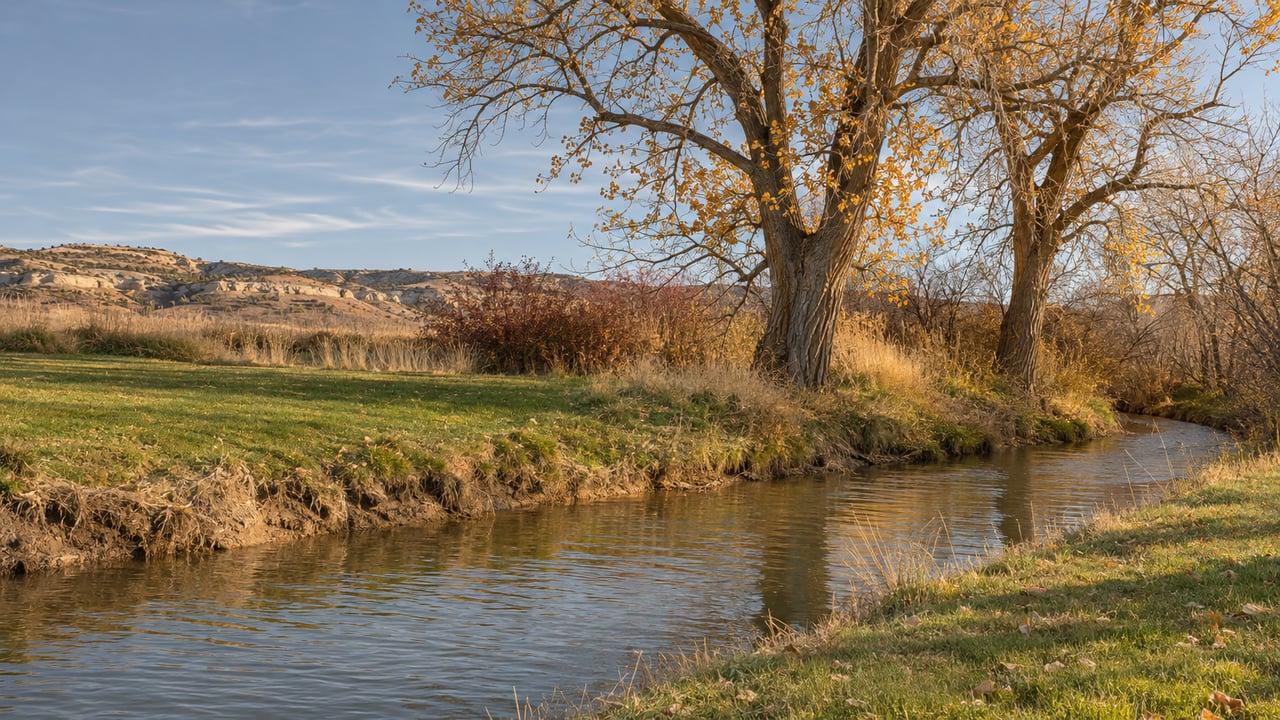
Redlands Water and Power is a nonprofit owned by its shareholders. It was organized in 1905, first delivered irrigation water in 1907, and was turned over to its shareholders in 1925. Its 2026 annual-meeting presentation lists 5,760 shares owned by 1,115 shareholders, covering about 4,500 acres through 26 miles of canals, five separate canals, four pump stations and four lift pipes. The same presentation says much of that infrastructure is more than 100 years old.
The water starts at a diversion on the Gunnison River about 2.4 miles above its confluence with the Colorado. According to the company's FAQ, up to 850 cubic feet per second goes into the Power Canal and travels about 2.7 miles to the hydropower plant and the main pump station. From there, depending on the property's location, it may pass through two more pump stations before it reaches a headgate. At the system's highest point, the water has been lifted more than 200 feet above the river.
That pumping is why Redlands irrigation behaves differently from the gravity-fed ditches around Palisade, which we covered in our post on how the 2026 drought shut those ditches off on different dates. Water reaching the upper Redlands depends on the river, the canal and a chain of pumps all working at once.
Three subdivisions, three arrangements
The company delivers water to headgates. What happens after that depends on how each neighborhood was set up. Three Redlands subdivisions show how far apart the setups can be.
| Subdivision | Source of yard water | Where the shared system ends | Detail from the HOA |
|---|---|---|---|
| Independence Ranch | Redlands Water and Power, 90 shares available to homeowners | Entry valve to each lot | Upper streets served by water pumped from a pond |
| Renaissance in the Redlands | Canal irrigation through an HOA-funded system | Property line | Owners manage and repair the rear-lot valve |
| Spyglass Ridge | Ute Water, bought by each owner | HOA irrigates common areas only | Lot owners buy their own outdoor water from Ute |
The details matter. At Independence Ranch, canal water comes in through an 8-inch pipe from a lateral at the upper end of Independence Valley Subdivision and passes through cleaning grates that need clearing daily. Homes on Stetson Court, Paint Pony Lane, Wrangler Way and the south side of Wrangler Court are served from a pond, and that water is pumped up to them. The lower end of the neighborhood gets its water straight from the pipe. The HOA's own page is candid: "Irrigation water is not tap water," supply is limited, and the company has outages during the summer. It says the most common causes are plugged grates and too little water being pumped up from the Gunnison.
At Renaissance in the Redlands, the HOA's management company posted that irrigation water was on as of April 27, 2026. The HOA pays for the system up to the property line, and each owner is responsible for breaks or repairs at the rear-lot valve.
Spyglass Ridge sits above the valley floor with views over the Gunnison canyon. Its fact sheet says common areas are irrigated and lot owners buy their irrigation water from Ute Water. These three are examples, not a map. Any other Redlands subdivision could work like one of them or differently, so check each one on its own.
What 2026 looked like on each side of the meter
On the canal side, Redlands Water and Power said water would go into the ditches on April 13, 2026. By late April the drought was already pressing. KJCT reported on April 28, 2026 that the company was asking customers and shareholders to conserve and asking HOAs to run odd-even watering rotations. The company said no restrictions were in place yet but that some could follow. The season ended with the company saying it had delivered water all season.
On the treated-water side, Ute Water says demand was climbing before summer started. Average customer use in March 2026 ran about 25% above the year before. The District applied drought rates to every account's June 2026 use, billed in July, and says the rates were meant to cut consumption, not raise revenue. On Ute's 2026 single-family rate sheet, a 14,000-gallon month cost $77.75 at the normal rate and $139.00 at the June drought rate.
Most of that kind of summer volume goes on the lawn. Ute's drought response page says "the District was not created to supply water for irrigation uses," and that for some customers who irrigate with its water, outdoor use can make up 80% or more of their monthly consumption. Ute returned all customers to its normal 2026 rates on November 1. So a buyer touring a Ute-watered Redlands home this winter is looking at a yard whose June 2026 water bill already showed what a dry year costs.
Canal water has its own costs. Shareholders are billed annual assessments, and in subdivisions owners commonly pay for irrigation through the HOA. A pumped system can also stop when a grate clogs, as the Independence Ranch HOA notes. Through the 2026 drought, though, the canal kept delivering while the price of treated water went up.
What to ask on a showing
Canal water brings share costs and the occasional clogged grate, and treated water brings bills that rise in a dry year. Before comparing two homes on price, these are the questions I'd want the seller and the HOA to answer:
- Where does outdoor water come from: Redlands Water and Power, Ute Water, or canal water for common areas and Ute for the lot?
- If it's canal water, who holds the shares that serve this lot, and what did the owner pay for irrigation in 2026, whether through assessments or HOA dues?
- Where does the shared system stop and the owner's own valve and sprinklers begin?
- If it's Ute Water, what did the July 2026 bill look like, since that was the bill that carried June's drought pricing?
Treat the numbers in this post as general information, not legal, tax or financial advice, and confirm the water arrangement on any specific property with the right professional.
For East Orchard Mesa, where several irrigation districts overlap, we covered the same kind of questions in our post on that tax-bill line item. The Redlands version is simpler on paper and still varies street to street.
The decision coming at the power plant
The hydro plant and main pump station at the bottom of that uphill chain are now under review. In its 2026 annual-meeting presentation, Redlands Water and Power said it is running a System Optimization Review to modernize the hydroelectric plant, the main pump station and other aging infrastructure. The first goal is to settle the best future layout for the plant and pump station sites. A condition assessment done in March 2022 found the plant "in good condition for its age" with high on-line availability, and said the governor pump and governor need upgrading or replacement.
The presentation lists three options. The first is to keep running the plant as it is, with only the repairs needed to keep it safe, for 15 to 20 years until shutdown or failure. The second is to modernize it for roughly $5 million to $12 million, which could extend its economic life to perhaps 100 years, with lost revenue during construction. The third is to rebuild it with modern equipment for an estimated $8 million to $10 million. The next annual shareholder meeting is February 10, 2027, and the company says details will go out in January. Anyone buying a canal-watered Redlands home this winter will be paying into that system while the shareholders weigh those options.
That changes what a canal-water home is worth to you. The irrigation that came through 2026 depends on 100-year-old infrastructure that its 1,115 shareholders will pay to keep running. Ute-watered homes avoid that. They pay treated-water prices, and in a dry year those prices go up. Both are reasonable choices, but they aren't the same, and the listing photo of a green lawn won't tell you which one you're looking at. If you're also weighing views and lot position, our guide to shopping for a view home in the Redlands covers the parts of a Redlands lot you can see from the street.
If you're comparing Redlands homes and want help confirming where each yard's water comes from, who holds the shares and what the 2026 bills showed, Laura Black can work through those answers with you, one address at a time. Schedule a consultation and bring the addresses you're considering.